 Tweets by @BadrJafar


UAE’s Resilience Under Pressure: DubaiEye Interview
Several weeks into this conflict – with sustained pressure on the UAE – how are the country’s systems performing?
What matters in moments like this is how do your systems perform under real pressure. And on that measure, the UAE’s systems are demonstrating exactly what they were built for. Core infrastructure is functioning – banking, telecoms, power, digital systems – they’re all operational. Our logistics networks have adapted fast – East coast ports like Khor Fakkan have stepped up to absorb cargo flows. DP World has activated land bridge routes so that containers can be discharged on the Gulf of Oman side and trucked to Jebel Ali under bonded transit. You’ve got companies like Etihad Rail, which is connecting it all. And these aren’t ad hoc fixes. This is contingency planning clicking into gear.
This is a country that handles over $1.4 trillion in trade every year – connecting to more than 180 ports – and these flows haven’t stopped. They’ve rerouted temporarily. And that adaptability didn’t happen by accident. It’s the product of five decades of deliberate investment in redundancy and, of course, diversification.
The real test of any system is never how it performs in calm. It’s how it performs under strain. And that test is being met.
Amid mixed and, at times, misleading international coverage, how is global confidence in Dubai and the UAE being affected?
We need to be honest, there’s been real disruption, particularly in sectors like aviation and obviously tourism. And that should be acknowledged, not just glossed over. But what I’d say to an international audience, and particularly to people viewing this from a distance, is to look at what’s actually functioning and how quickly systems are recovering.
The more relevant question isn’t how the UAE looks in isolation, but how it’s performing relative to any major global hub that’s ever operated under comparable pressure. And on that measure, what you’re seeing is continuity, not collapse. Markets have reopened, institutions are functioning, global firms remain present and committed. And wherever their company policies required, they’ve temporarily relocated stuff.
The fundamentals that underpin confidence haven’t changed:
- Foreign exchange reserves of over a trillion dirhams;
- Sovereign capital in the country of around $2.5 trillion, which is around five times the country’s GDP;
- Deep liquidity across the system;
- Central bank measures that were announced;
- Supply chains rerouting;
- Regulatory flexibility;
These are all actively supporting business continuity right now.
So, the real risk isn’t that confidence disappears; it’s that outdated narratives don’t keep pace with how the system is actually performing. Confidence follows performance; and performance has been strong.
What are global investors and business leaders asking about the status of the UAE right now?
Honestly, the most telling thing is what they’re not asking.
They’re not asking, ‘should we leave and when should we leave?’
They’re asking, ‘how do we position for what comes next?’
And of course, there are practical questions: staffing, continuity, logistics, travel. But strategically, in terms of serious investors, they recognize the structural strengths.
This is an economy that’s grown from around $40 billion in 1980, in terms of GDP, to over $500 billion today, with non-oil sectors now accounting for over 77% of GDP and foreign direct investment exceeding $45 billion last year alone. This growth story has endured multiple crises over this time: the Iran-Iraq War, the tie with the tanker wars, the Iraqi invasion of Kuwait, the global financial crisis, the Arab Spring, the pandemic.
Every single time there were breathless predictions about the end of the Dubai model or the UAE model. And every single time the system absorbed the shock and came back stronger. So amongst the investors I’m speaking with, the conversation has already shifted from risk avoidance to opportunity positioning. The fundamentals that held true just a few weeks ago haven’t disappeared. They’ve become, if anything, more relevant.
You’ve spoken about economic resilience—but what about the human side? How important has social cohesion been in this moment?
It’s absolutely central—and it begins with recognising the human cost.
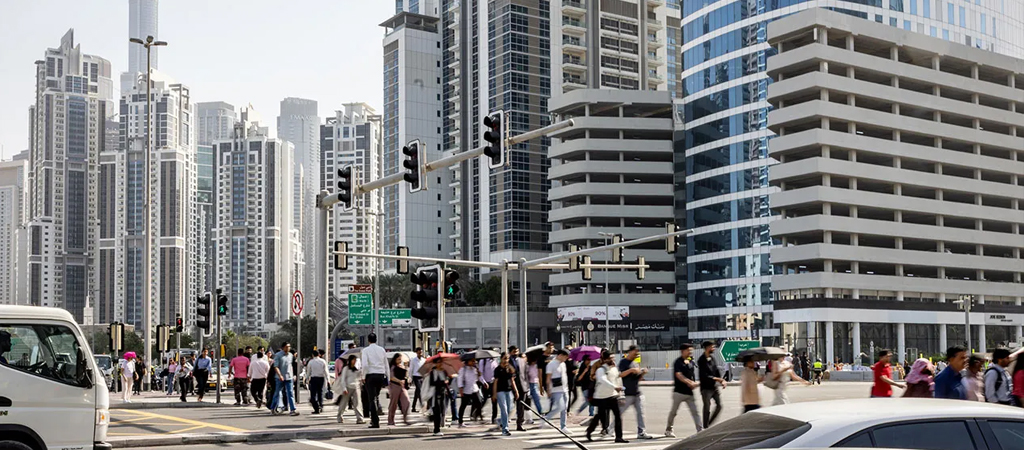
Eight lives have been lost, which is of course, tragic. Families have been affected and there’s been real fear amongst some. And none of that should be minimized in any way. But alongside this, there has been a remarkable sense of cohesion. People have kept showing up for work, for their communities, for each other. Businesses have adapted, and schools shifted seamlessly into temporary remote learning. Daily life has continued with a quiet sense of responsibility and calm that I think speaks to something deeper than infrastructure. It speaks to trust. And that trust reflects leadership.
His Highness Sheikh Mohammed bin Zayed’s message that everyone is Emirati through their contributions speaks directly to the 200 plus nationalities that call the UAE home, that make this country what it is: from business leaders to delivery drivers, from teachers to frontline teams.
Perhaps the most powerful example about this came just days into the crisis, during the month of Ramadan. The Edge of Life campaign, under His Highness Sheikh Mohammed bin Rashid and his initiative to combat childhood hunger, raised over 2.8 billion dirhams. In the middle of a crisis, this country broke records for humanitarian giving. That tells you everything about the character of this nation and this community.
With prepared leadership and committed people – resilience turns from a word into a lived reality.
You’ve said this isn’t just about infrastructure being targeted, but an “idea.” What do you mean by that?
The idea is that openness works – that you can build an economy on openness to people, to capital, to trade – and that this creates resilience, not fragility, even in one of the most complex regions on Earth.
When ports, airports, digital infrastructure are targeted, that’s not random – these are the arteries of global commerce. Take Dubai International Airport, the world’s busiest with 95 million passengers last year and the critical bridge connecting Europe and Asia. It is simply not possible to absorb those flows elsewhere in the global system. The UAE’s ports connect to over 180 markets globally, handling tens of millions of containers every year. These aren’t just national assets, they’re parts of the infrastructure that keeps the global economy moving.
So what’s being attacked isn’t just steel and concrete; it’s the proposition that a highly connected open economy can thrive under pressure. And what we’re seeing is that the model isn’t just holding, it’s proving its strengths. Which is exactly why it was built in this way.
Looking beyond the immediate crisis, how do you see the UAE’s global role going forward?
If anything, it reinforces the UAE’s role rather than change it. In a more volatile world, the kind of resilience the UAE has proven is a competitive advantage.
Before the crisis, roughly a third of business travel between Europe and Asia flowed through the UAE; about half of Europe-Australia passenger traffic passed through the Gulf; and around a fifth of the world’s oil and LNG transits the Strait of Hormuz. There simply isn’t spare capacity elsewhere to absorb this, so what’s at stake isn’t just regional, it’s the continuity of systems that underpin energy, trade, travel and, of course, essential goods worldwide.
The global economy was already entering a period of structural realignment in the months and years before this crisis. So, supply chains are already being rethought, capital is looking for nodes that are not just profitable, but durable.
The cities and systems that prove that they can absorb a shock of this magnitude and keep functioning will become more central to global commerce, not less. History is unambiguous on this point. So in essence, in a more fragmented world, resilience is no longer just a defensive quality; it’s a defining one. And that’s exactly where the UAE’s advantage is clearest.
Source: Omny FM