 Tweets by @BadrJafar


Resilience is Being Repriced — and the UAE is Ahead of the Curve
UAE core operating systems continued functioning energy grids remain stable
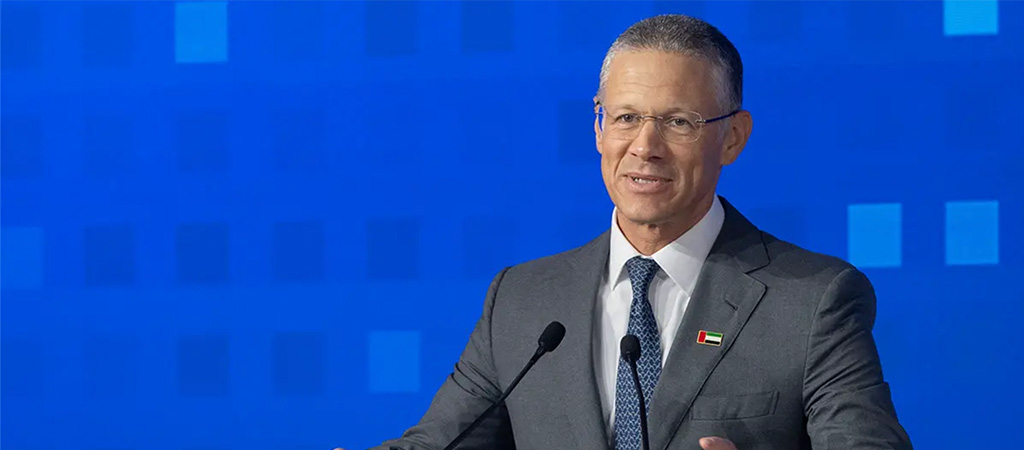
Recent disruptions to regional shipping lanes and trade corridors have put the resilience of Gulf economies under close scrutiny. Economy Middle East speaks with H.E. Badr Jafar — in his capacity as Special Envoy of the UAE Minister of Foreign Affairs for Business and Philanthropy and CEO of Crescent Enterprises — about what this moment reveals for investors, supply chains, and the long-term competitive positioning of the UAE.
Q. Regional disruptions have affected trade routes, aviation, and supply chains. A month in, what does this moment reveal about the UAE’s resilience?
A. The first thing to understand is that this is not a localized issue. The impacts reach far beyond the Gulf — Asian economies have felt the effects first, with rising costs for travel, energy, and food. That pressure is now moving west, driving inflation across Europe and the Americas.
Resilience — long treated as a cost — is now recognized as a core competitive advantage. The past few weeks have been a stress test that most systems were never designed to pass.
In the UAE, core operating systems have continued to function. Energy grids remain stable. Banking systems process transactions without interruption. Logistics networks adapted in real time, with supply chains that elsewhere would take weeks to adjust, reconfigured in days. This is not improvisation. It is the result of deliberate system design.
Q. What are the structural foundations behind that resilience — how was this built?
A. This is down to decades of deliberate design. The UAE’s GDP has grown from $40 billion in 1980 to more than $500 billion today — through multiple cycles of oil price shocks, regional turbulence, and global crises. Each time, doomsday predictions came from afar. Each time, the UAE emerged more connected and more indispensable.
Non-oil sectors now account for more than 77 percent of GDP, with non-oil trade growing 27 percent in 2024–25. Foreign direct investment exceeds $45 billion annually. A network of 32 Comprehensive Economic Partnership Agreements spans high-growth markets across Asia, Africa, and beyond.
But diversification alone is not enough. The UAE’s financial architecture is of unusual depth: sovereign wealth assets of around $2.5 trillion — roughly five times GDP — foreign exchange reserves exceeding $250 billion, and a well-capitalized banking system. These are not abstract figures. They represent shock absorbers that few nations possess.
Q. How has the policy response complemented those structural strengths?
A. Structural strengths provide the foundation — but in a crisis, policy responsiveness determines whether it holds. The speed and clarity of institutional action have been decisive. The central bank introduced a financial resilience package ensuring access to dirham and U.S. dollar liquidity. Dubai launched a $272 million private sector support initiative. Monetary intervention, regulatory coordination, and targeted sectoral responses worked in concert.
This is an often underappreciated dimension of resilience: not just the strength of the system, but the demonstrated ability to actively manage it under pressure.
Q. You’ve spoken about trust as a form of resilience. What do you mean by that?
A. The UAE is home to more than 200 nationalities. Observers expected an exodus. Instead, the vast majority stayed — and many who left temporarily returned. Businesses adapted. People kept showing up for work, for their communities, for each other.
That trust is not built overnight. It is earned through decades of consistent policy choices prioritizing stability, openness, and opportunity. And in moments of pressure, it becomes one of the most important forms of resilience an economy can possess. Economies do not function in abstraction — they function through people, and through the choices those people make about where to live, work, and invest.
The Edge of Life campaign, led by His Highness Sheikh Mohammed bin Rashid Al Maktoum, captured something of this spirit. In the middle of major disruption, this country raised over AED2.8 billion to combat childhood hunger — breaking world records for philanthropy. That tells you something important about the character of this nation.
Q. What are you hearing from the global business and investor community?
A. The expected opening question — ‘Should we reduce UAE exposure?’ — has shifted. What I hear now is: ‘Where else offers this combination of connectivity, institutional depth, and crisis-tested performance?’ The fundamentals are being reassessed, not dismissed. Capital is not withdrawing. It is recalibrating.
In the face of volatility, capital does not disappear — it concentrates. It flows to systems that prove reliability under pressure, not just promise it in stability. That is a higher bar, but also a more durable foundation for growth.
With more than $1.4 trillion in annual trade, connections to over 180 major ports, and the world’s busiest international aviation hub, the UAE is a critical infrastructure for the wider region and beyond. When both connectivity and continuity are maintained under stress, the value proposition speaks for itself.
Q. What does this moment mean for the region’s long-term economic positioning?
A. This moment does not redefine the UAE — it confirms decades of deliberate preparation. But it does signal a broader shift. The era of efficiency-optimized globalization is giving way to resilience-informed geoeconomics: systems designed not just for optimal performance in stable conditions, but for continued operation under stress. The distinction is not marginal. It will determine which economies sustain growth through volatility, and which fall behind.
In this environment, resilience is no longer reactive — it is predictive. The UAE is not adjusting to this shift. It anticipated it. The question is no longer whether resilient systems command a premium. It is whether less resilient systems can compete at all. That repricing has already begun. And it is irreversible.
Source: Economy Middle East